Adam Emory Albright, from a photograph of circa 1915, from the Ivan Albright Collection, Ryerson and Burnham Libraries, Art Institute of Chicago.
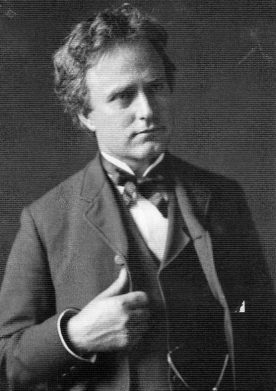
Adam Emory Albright 1862–1957
Escaping the grinding poverty of his family’s farm in Iowa, Adam Emory Albright arrived in Chicago in 1882 at age nineteen determined to become an artist. He studied briefly at the Art Institute of Chicago’s school before enrolling in 1883 in the Pennsylvania Academy of the Fine Arts in Philadelphia, where he studied with realist master Thomas Eakins. Albright then spent two years in Europe, working under established figural painters in Munich and Paris. By 1888 the newly married artist was settled in Chicago, struggling to support himself by making portraits and painting moralizing images of newsboys, bootblacks, and other youthful urban types.
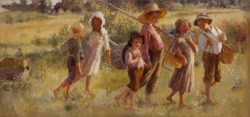
Albright’s prospects changed following the births of his twin sons, Ivan and Malvin, and the family’s move to a newly built log cabin residence in northwest-suburban Edison Park. Around 1899, using his own family and neighborhood youths as models, he began painting children in bucolic outdoor settings. Albright’s carefree barefoot boys and girls idle at fishing streams, wander homeward from the fields, gather wildflowers or fruit, and otherwise testify to country childhood as a fleeting moment of innocent pleasures under perpetually sunny skies. These painted fictions—remote indeed from the artist’s hardscrabble youth—were the mainstay of a long and highly successful career. They appealed powerfully to contemporary Chicagoans, many of whom cherished nostalgic memories of their own rural origins, bemoaned the dizzying pace of life in the modern metropolis, and worried over the plight of urban child laborers and slum-dwellers. The Art Institute honored Albright with five solo exhibitions (more than any other artist in the first half of the twentieth century) and he was noted among Chicago artists for never having to supplement his income from art-making by teaching or other activities. Renowned as the “farmer-artist,” Albright was active in numerous Chicago art organizations and championed local artists.
In 1910, with Edison Park losing its rural character, Albright built a much larger log studio-residence in the Hubbard Woods section of Winnetka, and in the mid-1920s he moved again, to Warrenville, Illinois. Accompanied by his family, Albright also traveled widely, visiting Wales and Venezuela as well as New England, Pennsylvania, Indiana, and California. While adhering closely to his signature subject matter, he loosened his brushwork and brightened his color under the influence of impressionism. In the face of more avant-garde trends, however, Albright emerged as a staunch defender of traditional pictorial values. Ironically, his twin sons became prominent modernist artists: Ivan, in particular, was noted by the late 1920s for figural images of scathing hyper-realism that contrasted sharply with his father’s cheerful sunlit scenes. Yet father and sons shared a studio, and in 1950 they even exhibited together. Described as one of Illinois’ “best conservative artists, untouched by modern influences,” Adam Emory Albright died at age ninety-five.i
Wendy Greenhouse, PhD
i William Vernon, “Fine Exhibits Are Shown at the Art Institute: ‘Farmer-Artist’ and his Chief Canvas Now on Exhibition,” Chicago American, Oct. 3, 1902.