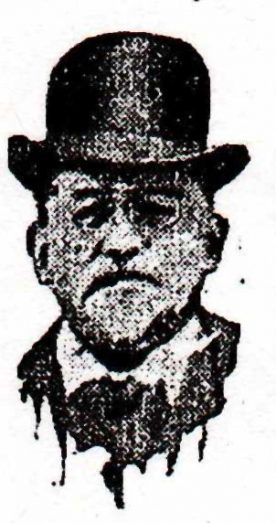
Albert Fleury, from a photograph published in Chicago Tribune, Feb. 2, 1924.
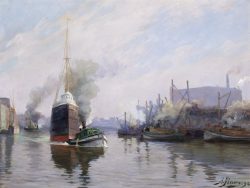
Albert Fleury 1848–1924
Albert François (or Francis) Fleury was born in the French port city of Le Havre and studied decorative painting and architecture in Paris. He arrived in the United States around 1888 to assist his former teacher Emile Rénouf on a large-scale painting of the Brooklyn Bridge. Shortly thereafter Fleury was in Chicago with a commission to contribute to the decoration of the new Auditorium Building, a combined hotel, theater, and office building designed by the partnership of Dankmar Adler and Louis Sullivan. In addition to a series of panels for the hotel dining room, he painted two large landscapes for the theater inspired by verses written by Sullivan; the young painter Oliver Dennett Grover assisted with the execution. Fleury completed numerous other mural projects in private homes and public buildings in several midwestern cities as well as in New Orleans, and he was in charge of decorations for the Palace of Mines and Metallurgy at the Louisiana Purchase Exposition held in St. Louis in 1904.
In addition to large-scale works, Fleury painted easel-size landscapes, first exhibiting with the Chicago Society of Artists and at the Art Institute of Chicago beginning in 1898, the year he joined its faculty. He also conducted his own summer outdoor sketching classes. Turning his artistic attention to the city itself, Fleury showed a Chicago River scene in his debut at the Art Institute. There, his 1900 solo exhibition “Picturesque Chicago,” featuring forty-five oil and watercolor paintings, caused something of a sensation. The artist, critics enthused, had proven that even Chicago’s most typically prosaic scenes, such as the polluted river and smoke-shadowed street canyons, could be artistically, even poetically, interpreted. “It has remained for an academician of France to reveal Chicago’s picturesque side to her most patriotic citizens,” remarked one writer, no doubt unaware that the obscure painter James Bolivar Needham had by then been painting the river for a decade.i Fleury’s Chicago images were widely reproduced in newspapers, journals, and postcards, and his work set an example for local artists, who subsequently competed in painting their city.
Chicago remained Fleury’s primary landscape subject. Active in several local artists’ organizations, he was among the founders of the Chicago Water Color Club in 1907. Fleury taught still-life painting and architectural rendering in the Art Institute’s school until 1918. By that date, the artist had largely ceased exhibiting, although he continued to paint until shortly before his death at age seventy-five.
Wendy Greenhouse, PhD
i “Art and Artists,” Chicago Journal, Oct. 13, 1900.